26 July 2012


co+labo

RESEARCH PUBLICATION: THE SPLIT CASE

The Split Case: density, intensity, resilienceedited by Darko Radović, Davisi Boontharm Ana Grgić and Kengo Kuma, Tokyo: IKI and flick Studio, a publication of our major IKI research project  Measuring the non-Measurablewhich focuses on issues of urban density, intensity and public/private interface at architectural and urban scales has been just published by IKI and flick Studio (in collaboration with ichii Shoubou, Studio Seto and Tokyo Pistol). The book will first be available through Amazon.co.jp, and then in all major bookstores.

Contributors: Darko Radović, Kengo Kuma, Davisi Boontharm, Katja Marasović, Snjezana Perojević, Darovan Tušek, Ante Kuzmanić, Robert Plejić, Ana Grgić, Hrvoje Bartulović
with students from Kuma Laboratory (University of Tokyo), co+labo Radović (Keio University), and FGAG (Split) who took part in the Split Workshop 2011led by Milica Muminovic, Ilze Paklone, Rafael A. Balboa, Wataru Hashida, Komatsu Katsuhito, Bojan Koncarevic, Masato Shinohara.

This is a book about the ancient city of Split in Croatia. It presents research of remarkable intensity and resilience of its urban core, which sustains and keeps on reinventing a unique urbanity, for nothing less than 1700 years. The Split Case brings together knowledge and lived experience of local authors, and curious and expert observations of the foreigners. In the form of a guidebook, inspired by Situationist dérive, it offers  three "walks" through Diocletian PalaceThe first is the walk through history, guided by the best of local academics, deeply steeped into the vécu of their city. After that, a number of snapshots gathered during an intensive investigation of that space, recreate the walks conducted in only one of the 88,660 weeks in the history of Split. This multiple dérive  ends with some open-ended walks into the future, presented through an invitation into some of the most precious small spaces the Palace

From the book (part of the visual essay The Charts of Edges, by Koncarevic et al.)

21 July 2012


July 2012
design presentations by co+laboradović students

At Keio, we are trying to improve the quality of teaching in the fields of architecture and urbanism. In spring semester 2012, co+labo students were, thus, involved in three exciting studios. These pictures bring some of the atmosphere from their interim and final presentations.

IKI Masters project - Miyatojima
Sejima Kazuyo (studio leader), Bill Galloway, Kobayashi Hiroto and Darko Radović
                                                                                                                                                          
Studio B Masters project: Sou Fujimoto (studio leader)
examination panel: Jorge Almazán, Darko Radović (coordinator), Kishimoto Tatsuya (TA Komatsu Katsuhito)


Seizu III UG Project: Jorge Almazán, Darko Radović (coordinator), Kishimoto Tatsuya 
examination panel: Harada Masahiro, Heide Imai, Salvator-John Liotta, JA, KT, DR


11 June 2012


***LATEST*** June 2012

co+laboradović publications

co+labo A1 newsletter urbophilia - toshi aiissues 2 and 3


Measuring the non-measurable (above) 

co+labo production of an newsletter-info sheet reporting from the major reserach Symposium held at Keio in November 2011


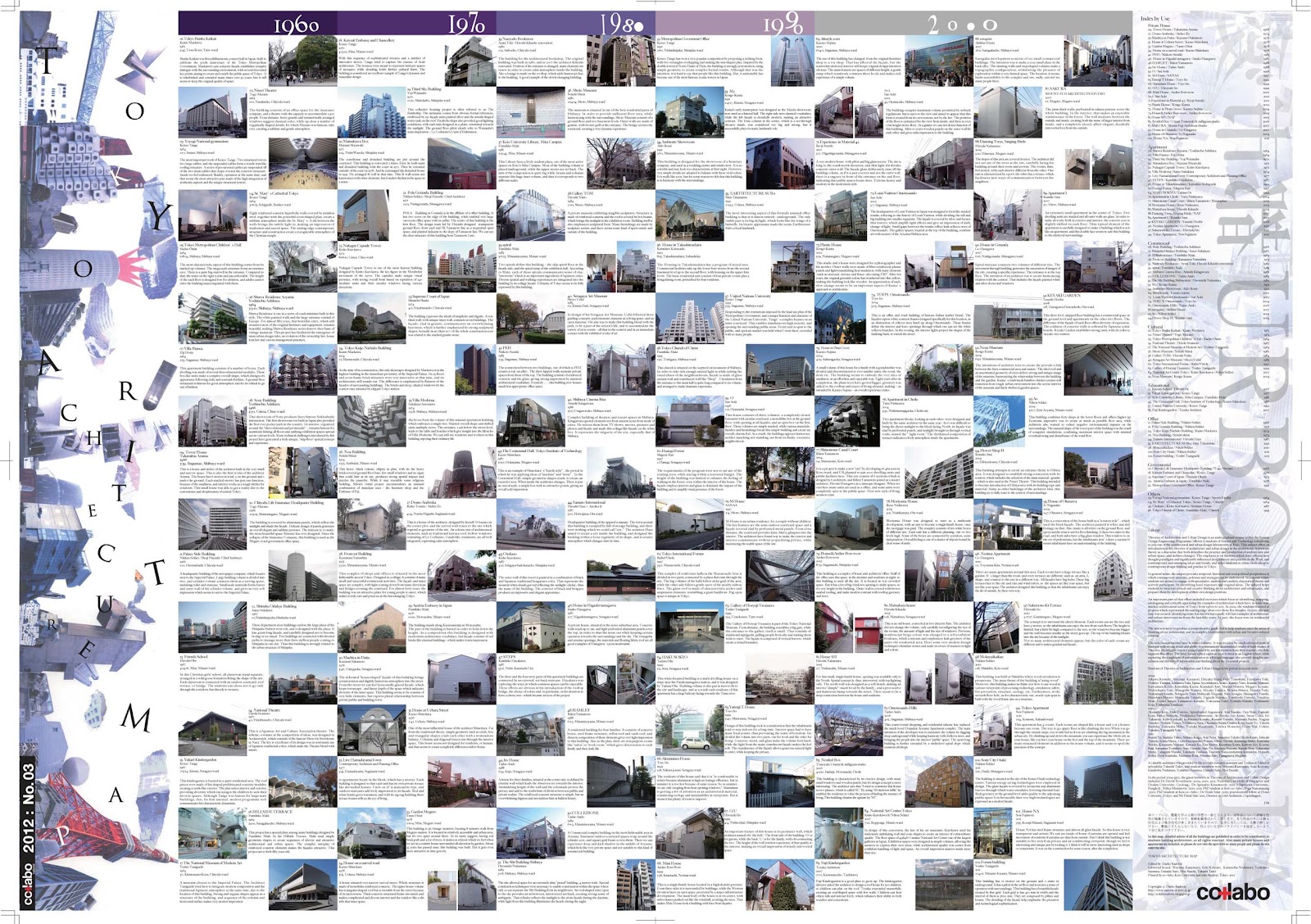
Tokyo Map (above) 
an informative sheet representing a selection of cases studied within Theories of Architecture and Urban Design in the period 2009-2012. An useful guide for anyone wanting to find and explore exemplary architecture of Tokyo 1960's-2000s. The A1 map and the information sheet, above were produced by a group of undergraduate students.

07 June 2012


7 June 2012 @ co+laboradović 2012
ARCHITECTURE AND URBANISM @ KEIO
Barrie Shelton
held a research seminar
Learning from the Japanese City: Cultural Predispositions in Design
We all carry cultural predispositions acquired through the practice and observation of everyday things - as in Pierre Bordieu's concept of habitus. The actions (as in design) and results (patterns and forms) are so familiar that we do not pause to think - they become 'second nature'.  The seminar will explore spatial predispositions in Japanese culture across several scales from the humble QR code to the structure and appearance of cities with some attention to the Japanese writing system. This is a theme commenced in my book, Learning from the Japanese City.
Barrie Shelton is Associate Professor - Urban Design at the University of Melbourne. His areas of expertise are in urban design, history and theory, and urban morphology, with special interests in East Asia and particularly Japan. He has directed postgraduate urban design and town planning programs at the Universities of Sydney (2002-10) and Tasmania (1990-97). His most important recent works are The Making of Hong Kong: from Vertical to Volumetric (co-author 2011) and Learning from the Japanese City: Looking East from Urban Design (2012), both published by Routledge, London & NY. He is an executive member of the International Society for Engineering and Design (ISHED).

05 June 2012


 a co+labo update


FIELDWORK MELBOURNE DOCKLANDS


co+labo team has completed the fieldwork for a major urban design-reserach project to be conducted in the laboratory June-October 2012


(details to be posted soon)
Akatsuka,
Radovic,
Kato,
Suzuki,
Ishikawa,
Kozono,
Minegishi @ StKilda Pier


16 May 2012


16 May 2012
co+laboradović research seminar
Research-in-progress presentations Milica Muminović and Pega Sanoamuang

Milica and Pega presented their work on Branding Yanesen: the role of re-memory in preservation of assembled identity of place and The impacts of introducing new transportation networks in a neighborhood; Case study Wat Mangkorn station, Bangkok and received rich feedback from discussion panel - Honda Satoshi (Keio), Hashimoto Tamao (Geidai), Julian Worrall (Waseda), Jorge Almazan (Keio), Heide Imai (Hosei), Wanyu Shi (UNU) and Davisi Boontharm (Deakin, who joined discussion on-line).
Honda Satoshi (Keio), Hashimoto Tamao (Geidai), Julian Worrall (Waseda), Komatsu Katsuhiko (Keio co+labo), Jorge Almazan (Keio), Heide Imai (Hosei), Wanyu Shi (UNU).